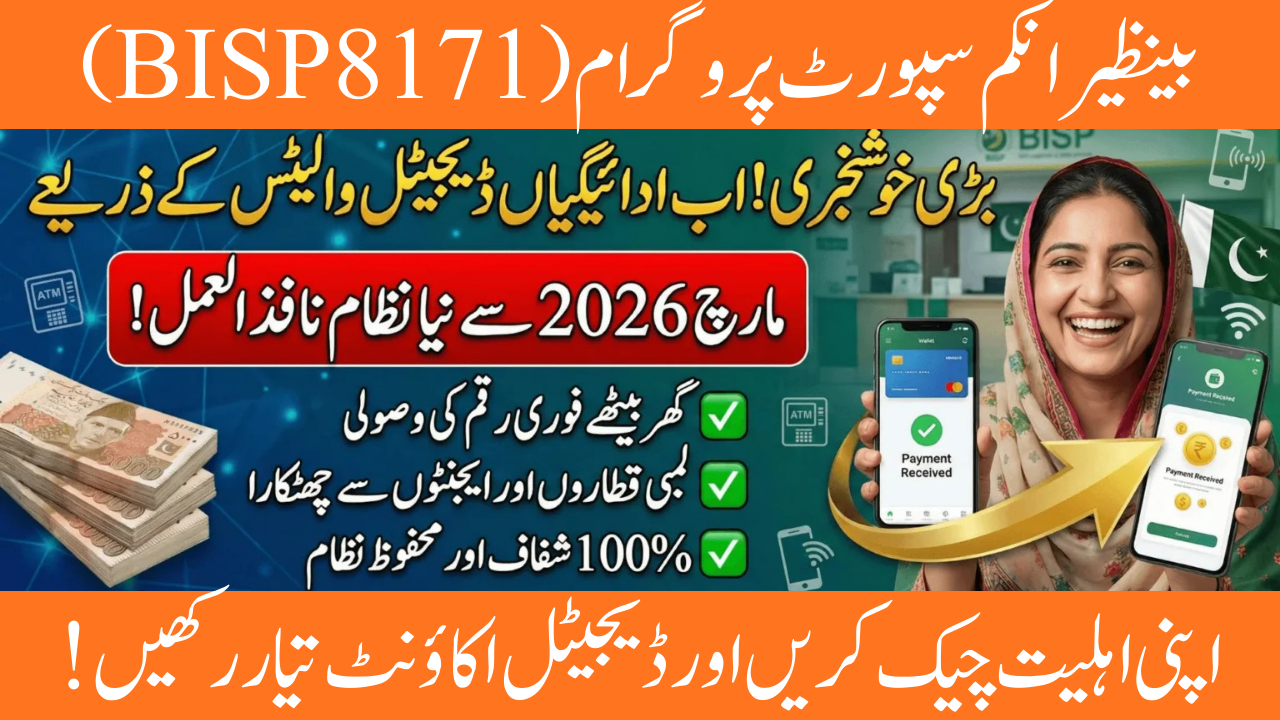
Beneficiaries of BISP 8171 Will Get Payments Through Digital Wallets
Beginning in March 2026, BISP 8171 clients will receive payments via digital wallets, revolutionizing the way social welfare aid is provided in Pakistan. With the goal of helping millions of low-income families, this program represents a transition from conventional cash-based techniques to a totally digital payment system.
Read more: The Complete Guide to BISP Digital Bank Accounts 2026 How to Get the Rs. 13500 BISP Qist
It is anticipated that 10 million eligible beneficiaries would use this digital system by March 2026, making BISP one of the nation’s biggest digitally run welfare programs. This change is in line with the government’s objectives of improving inclusiveness, efficiency, and transparency. It is especially important for women since it allows them to safely access cash from home without depending on outside parties.
Make the switch to an all-digital payment system
A major change to the program is the implementation of digital wallets under BISP 8171. By removing middlemen and cutting down on delays related to the prior cash distribution scheme, this system allows direct quarterly payments to recipients’ registered digital wallets connected to their CNIC and cell numbers. Secure wallet access has been made possible by the creation of millions of digital accounts and the issuance of SIM cards in the recipients’ names for those without cell phones.
Beneficiaries may access cash via authorized agents or ATMs, check balances, and get payment alerts, all of which improve convenience and financial literacy. In addition to helping with transaction management, this exposure to digital finance may open doors to other financial services, strengthening the financial resilience of households.
Federal Authorities’ Official Confirmation
In order to improve the payment system for millions of beneficiaries, the Federal Minister for Poverty Alleviation declared before the National Assembly that BISP payments will switch to digital wallets by March 2026. The goal of this change is to reduce complaints over unapproved deductions and payment delays. Women who participate in the Benazir Kafalat Program will gain the most, as they won’t have to physically obtain aid. Since direct transfers to individual wallets improve accountability and transparency within the welfare system and lower the possibility of corruption, the action is meant to strengthen confidence between recipients and governmental organizations.
Increasing Data Correctness and Preventing Abuse
Large-scale welfare programs, like those carried out by BISP, depend on accurate data administration. BISP has strengthened its data verification and monitoring mechanisms to improve the accuracy of its beneficiary records, particularly through a data-sharing arrangement with Pakistan Bait-ul-Mal for cross-checking records. Many inaccurate registrations were eliminated as a result of this verification procedure, increasing the accuracy of the beneficiary database.
This program demonstrates the government’s commitment to upholding justice and safeguarding public finances. In order to prevent fraud, maintain up-to-date household information, and improve program transparency, BISP plans to deploy sophisticated digital verification technologies, update databases more often, and establish ongoing monitoring.
Budget Support and Financial Planning for BISP
Effective financial planning is essential to managing a welfare program. The government confirmed a Rs 716 billion allocation for the Benazir Income Support Programme as a result of recent parliamentary talks on budget sufficiency for growing digital infrastructure. Cash transfers, administrative tasks, and digital improvements are all included in this budget.
You can read more: The Complete Guide to BISP 8171 Payment using Easypaisa and JazzCash 2026
Officials stated that the allotted monies are adequate for continuous payments to recipients even though they do not directly receive foreign exchange reserves. BISP seeks to improve resource utilization, guarantee aid reaches worthy families, and bolster the program’s sustainability by reducing inefficiencies through digital disbursement.
| Category | Details |
|---|---|
| Program Name | BISP 8171 Digital Wallet System |
| Start Date | March 2026 |
| Payment Method | Digital wallets linked to CNIC and mobile number |
| Target Beneficiaries | Around 10 million low-income families |
| Primary Beneficiaries | Women under Benazir Kafalat Program |
| Payment Frequency | Quarterly cash transfers |
| Access Methods | Mobile wallets, authorized agents, ATMs |
| Main Purpose | Improve transparency, reduce delays, prevent deductions |
| Data Verification | NSER updates and cross-checking with Pakistan Bait-ul-Mal |
| Total Budget Allocation | Rs. 716 billion |
| Key Benefits | Faster payments, reduced fraud, financial inclusion |
| Eligibility Basics | Valid CNIC, NSER registration, low poverty score |
| Documents Required | CNIC, mobile number, NSER/FRC, utility bill (if required) |
Who Is Eligible for the Benazir Kafalat Program?
- Eligibility for the Benazir Kafalat Program targets the poorest households.
- The program prioritizes women due to their role in household management.
- Applicants must be Pakistani citizens with a valid NADRA-issued CNIC, registered in the National Socio-Economic Registry (NSER).
- Eligibility is determined through a poverty score, only considering households below a specific threshold.
- Exclusions apply to individuals employed by the government, property owners, and those with significant assets.
- Men are typically not eligible as primary beneficiaries, with exceptions in specific policy-defined cases.
- These measures aim to allocate resources to families in genuine economic need.
Documentation Required for Enrollment Success
- Accurate documentation is crucial for the registration process.
- Additional documents may include utility bills, family registration certificates, and children’s school records for household verification.
- Special cases (widows, divorced women, and persons with disabilities) must submit relevant certificates.
- Maintaining precise records prevents misuse of funds and ensures continuous assistance for eligible families.
Overview of Eligibility Requirements
- Citizenship: Pakistani national with valid CNIC
- Gender Preference: Women prioritized
- NSER Registration: Mandatory
- Poverty Score: Below defined threshold
- Employment: No government job
- Assets: No property ownership
Read more: 8171 BISP Token Slip 2026
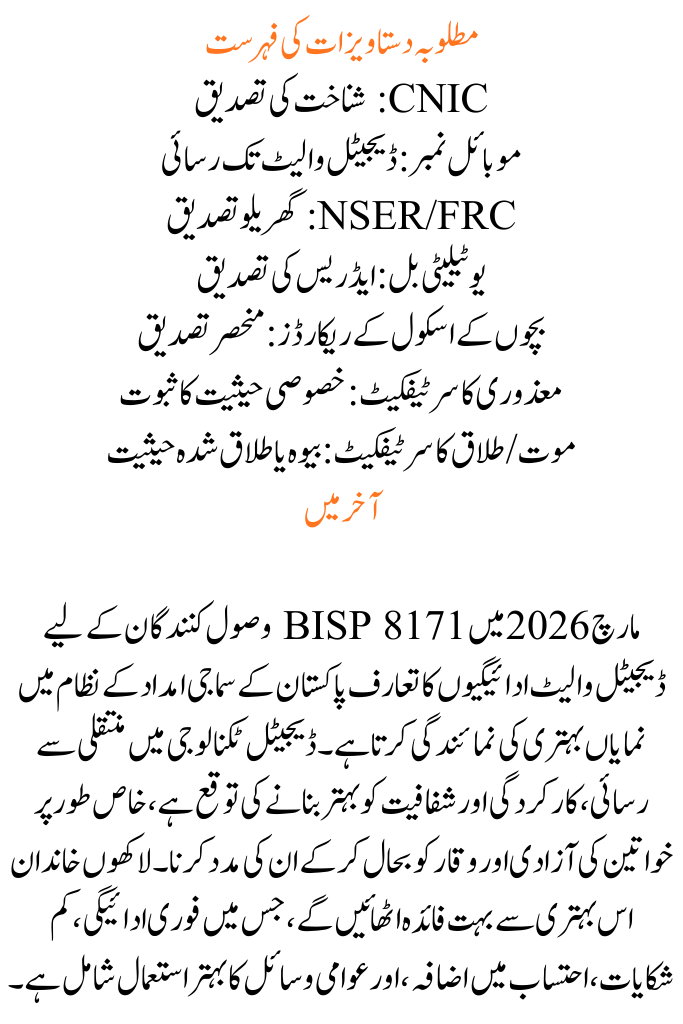
List of Documents Needed
- CNIC: Identity verification
- Mobile Number: Digital wallet access
- NSER / FRC: Household verification
- Utility Bill: Address confirmation
- Children’s School Records: Dependent verification
- Disability Certificate: Special status proof
- Death/Divorce Certificate: Widow or divorced status
In conclusion
The introduction of digital wallet payments for BISP 8171 recipients in March 2026 represents a significant improvement in Pakistan’s social assistance system. The transition to digital technology is expected to improve accessibility, efficiency, and transparency, especially helping women by reestablishing their freedom and dignity. Millions of families will benefit greatly from the improvements, which include quicker payments, fewer complaints, increased accountability, and better use of public resources.
FAQs
1. When will payments using the BISP 8171 digital wallet begin?
Payments using the BISP 8171 digital wallet will begin in March 2026. Instead of cash, eligible recipients will get their quarterly rewards straight into their registered digital wallets.
2. How will the digital wallet be used to transfer funds to recipients?
Direct payments will be made to a digital wallet connected to the beneficiary’s mobile phone and CNIC. Beneficiaries may check accounts, take out cash from approved agents or ATMs, and get SMS payment alerts.
3. Who may use the BISP digital wallet to accept payments?
Payments are only available to qualified women who are enrolled in the NSER database, have a valid CNIC, and have a low poverty score. Households with substantial assets, property owners, and government personnel are not eligible.