8171 New Update 2026
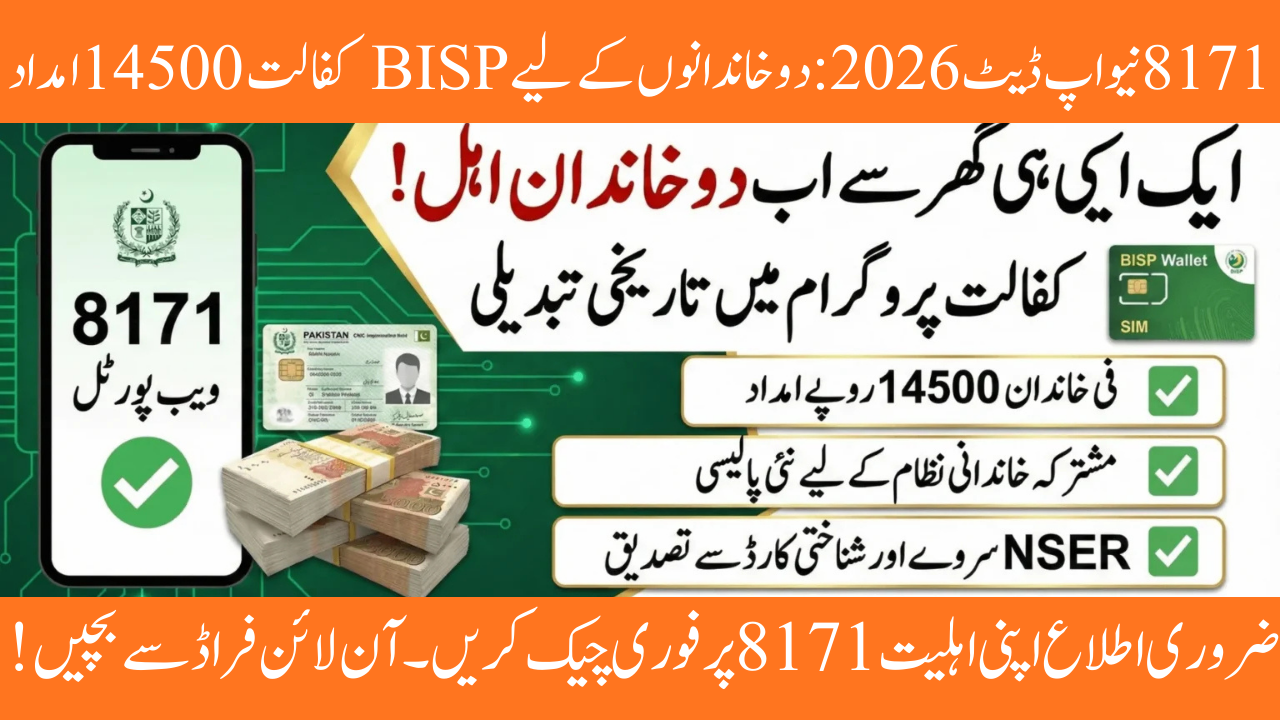
8171 New Update: Two families residing at the same home can now qualify separately for the Kafalat plan, which has raised its payout to Rs. 14,500, thanks to significant improvements made by the 2026 Benazir Income Support Program (BISP). The goal of this update is to increase financial assistance for low-income households, with a focus on women-led families in joint family systems. Furthermore, digital verification and mobile payment solutions are improving the delivery procedure, which is a big stride for social assistance in Pakistan.
You can read more: Benazir Income Support Program 2026 (BISP): Detailed Registration Instructions, Qualifications, and Necessary Records
The 8171 New Update for 2026’s Objective
- The 8171 New Update 2026 aims to address gaps in the social protection system.
- Previously, many families were deemed ineligible for assistance due to living with extended family.
- The policy seeks to align with the financial realities of joint families that include multiple low-income households.
- Key objectives include improving fairness in beneficiary selection and ensuring accurate poverty assessment.
It aims to expand coverage to families that have been overlooked and eliminate reliance on manual decision-making. - The redesign of eligibility processes aims to enhance inclusivity and transparency in financial aid distribution.
Reasons for Reexamining Joint Families
- Joint family living in Pakistan is influenced by factors like inflation, unemployment, and housing shortages.
- Multiple married couples may share a residence while managing finances separately.
- The previous BISP system inaccurately treated these households as single financial units, resulting in exclusion.
- The new update recognizes the following:
- One address does not equate to one financial unit.
- Economic independence is prioritized over shared residence.
- Women from separate family units deserve equal consideration.
How Two Families May Be Eligible for One Roof
- The rule permitting two families from the same household to qualify is conditional.
- Eligibility requirements include:
- Two distinct female family heads.
- Independent management of expenses by each family.
- Separate marital or dependency status as indicated in CNIC records.
- Survey data confirming separate financial units.
- Upon verification through NADRA and the dynamic survey, both families may receive Kafalat payments independently.
Women-Centered Eligibility’s Function in BISP Kafalat
- The Benazir Kafalat Program aims to empower women through financial support.
- Payments are made directly to female beneficiaries to promote household financial stability.
- Priority is given to:
- Widows without regular income
- Divorced or separated women
- Women supporting children alone
- Families with disabled or elderly dependents
Kafalat Payment Increase to Rs. 14,500
- The BISP Kafalat payment for the 2026 cycle has risen to Rs. 14,500 per eligible family.
- This increase is in response to rising living costs.
- Aims to enhance support for essential needs, including food, education, and healthcare.
- Intended benefits include helping families cope with inflation and improving nutritional and educational
- outcomes, and reducing reliance on informal loans.
Reassessment of the 8171 System and Dynamic Survey
- The 8171 system has transitioned to utilizing updated survey data.
- Families that were previously marked as ineligible are undergoing reassessment.
- A dynamic poverty scoring model is being used for the reassessment, which evaluates:
- Household income sources
- Number of dependents
- Employment status
- Housing conditions
You can read more: A New Era of BISP Reforms for 2026: Updated Eligibility Requirements, Increased Stipends, and Digital Wallet SIMs
| Category | Details (8171 New Update 2026) |
|---|---|
| Program Name | Benazir Income Support Program (BISP) – Kafalat |
| New Rule | Two separate families can qualify from one house |
| Payment Amount | Rs. 14,500 per eligible family |
| Eligible Beneficiaries | Women-led low-income families |
| Joint Family Policy | One address can have multiple financial units |
| Key Requirement | Separate female family heads with CNIC records |
| Verification Method | NADRA & biometric verification |
| Survey System | Dynamic Poverty Survey (updated data) |
| Eligibility Check | SMS CNIC to 8171 |
| SIM Requirement | SIM must be registered on applicant’s CNIC |
| Payment Start | Expected in early 2026 (phased distribution) |
| Payment Method | Digital & mobile-based payment systems |
| Main Objective | Fair distribution and inclusion of joint families |
| Fraud Protection | Only trust messages from 8171 |
NADRA Verification Procedure and Biometrics
- All applicants must undergo biometric and NADRA verification to ensure transparency.
- This process aims to:
- Ensure payments only go to genuine beneficiaries.
- Eliminate duplicate registrations.
- Prevent identity fraud.
- Applicants with biometric issues should update their records at NADRA centers prior to reapplying.
How to Use 8171 to Verify Eligibility
- The government has made the eligibility checking process straightforward and user-friendly.
- Users should:
- Open their mobile messaging application.
- Type their 13-digit CNIC number.
- Send it to the number 8171.
- After sending the message, users should wait for an official reply.
- The response will indicate if they are eligible, under review, or need to complete additional verification.
The Value of Using a CNIC-Registered SIM
- Using a SIM registered on your own CNIC is mandatory.
- Many applications are rejected due to mismatches between CNIC and SIM ownership.
- To avoid issues:
- Use your personal registered SIM.
- Avoid using relatives’ phone numbers.
- Keep your SIM active.
Anticipated Payment Plan for 2026
- Payments are expected to begin in early 2026, with exact dates to be announced officially.
- Distribution will occur in phases to maintain system stability.
- Beneficiaries are advised to:
- Monitor official announcements
- Respond promptly to verification messages
- Keep documents updated
Typical Causes of Disqualification
Technical problems, such as inaccurate or out-of-date CNIC data, biometric mismatches, incomplete household surveys, or presently receiving other government financial aid, may cause some applications to be refused even if they fit poverty standards.
Defense Against False Communications and Fraud
- Scams increase with major updates; applicants should be cautious.
- BISP will never ask for money.
- No agent can guarantee approval of applications.
- OTP codes must never be shared.
- Only trust messages sent from the number 8171.
You can read more: 13500 January 2026 Eligibility Check for BISP 13500 Payment Notifications
Why the New Update for 8171 Is a Good Development
- The 8171 New Update 2026 offers a more realistic understanding of poverty in Pakistan.
- It acknowledges separate family units within joint households.
- The government is increasing financial support to create a fairer welfare system.
- Reforms include expanding program reach, reducing exclusion errors, promoting digital transparency, and strengthening women’s financial security.
Why the New Update for 8171 Is a Good Development
- The 8171 New Update 2026 enhances the understanding of poverty in Pakistan by acknowledging separate family units within joint households.
- The government is increasing financial support to move toward a more equitable welfare system.
- Key reforms include:
- Expansion of program reach
- Reduction of exclusion errors
- Promotion of digital transparency
- Strengthening of women’s financial security
In conclusion
The BISP Kafalat program has significantly improved with the recent news that two families can qualify under one home. This 2026 update offers suffering families fresh hope along with the Rs. 14,500 payment and improved verification mechanisms with clear eligibility checks via 8171. To maximize the program’s advantages, accurate record-keeping, truthful survey participation, and adherence to official protocols are crucial. Maintaining awareness and being watchful is essential to getting the aid to which qualified people are entitled.
FAQs
1. Are BISP Kafalat payments available to two families residing in the same home?
Indeed. Two families residing at the same location may be eligible separately under the 8171 New Update 2026 if they have different female family heads, are financially independent, and their details are confirmed by the dynamic survey and NADRA records.
2. What is the 2026 BISP Kafalat payment amount?
For each qualifying household, the BISP Kafalat payout has been raised to Rs. 14,500. The goal of this increase is to assist low-income households in coping with growing living expenses, such as those related to food, healthcare, and education.
3. How can I find out if I qualify for the 8171 program?
Enter your 13-digit CNIC number in the mobile message box and send it to 8171 with a SIM card linked to your own CNIC to verify your eligibility. A response verifying your status or requesting more verification will be sent to you.